VISIONAIR Project Educational Activity at the University of Zagreb
15.05.2026 | Tomáš Poláčik
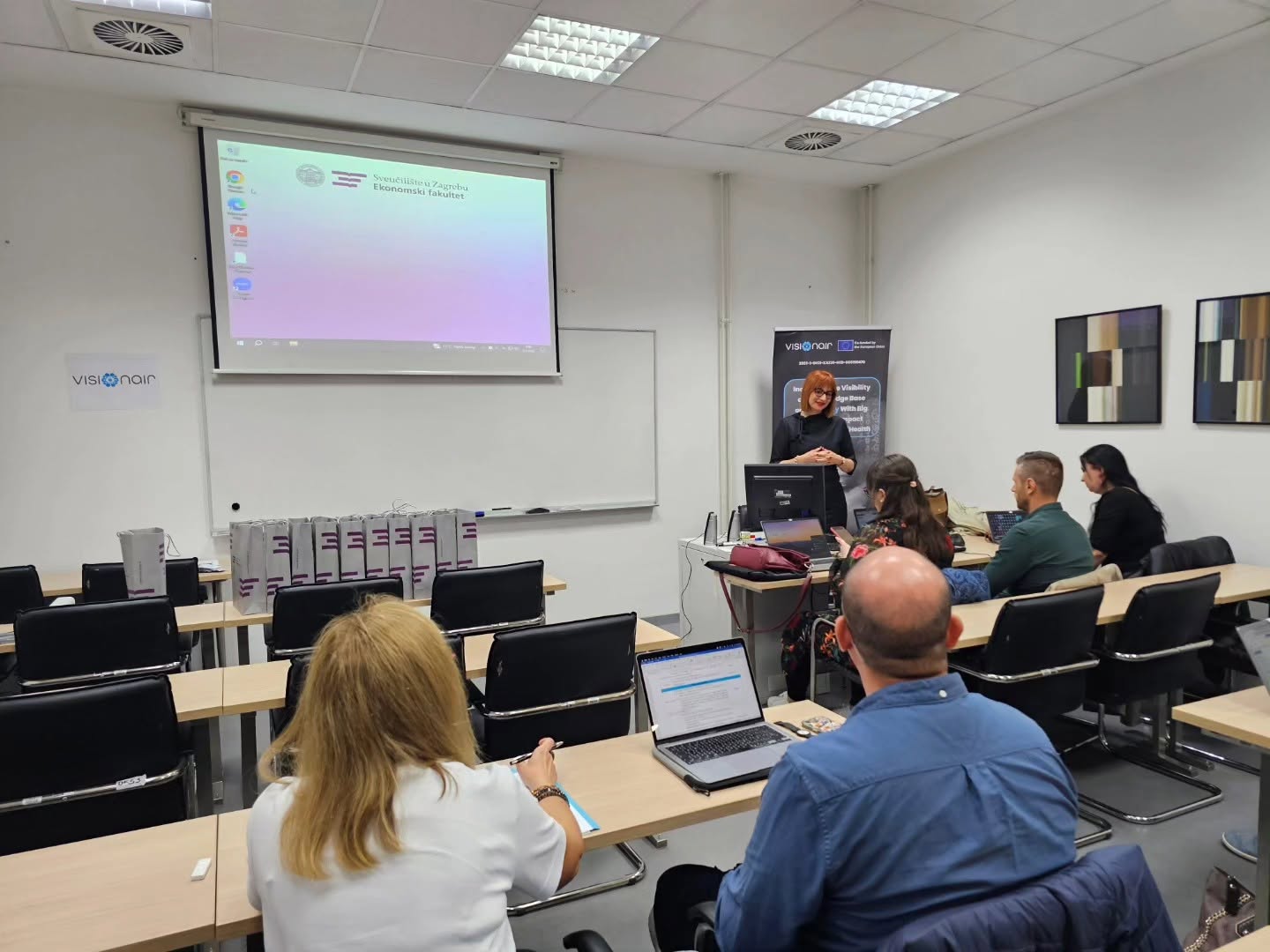
From May 4 to 7, 2026, the Faculty of Economics and Business at the University of Zagreb hosted the third training activity as part of the international project “Increasing the visibility and knowledge base on air quality with big data and its impact on the population health” (VISIONAIR), implemented under the Erasmus+ KA220-HED Cooperation Partnerships program, No. 2023-1-SK01-KA220-HED-000158470. The Slovak University of Agriculture in Nitra was once again represented at the meeting by the project’s lead coordinator, Assoc. Prof. Ing. Jakub Berčík, PhD., Dr. Anna Mravcová, and Dr. Jana Gálová.

The first day of the training was devoted to the economic consequences of air pollution in the European Union and the factors influencing morbidity and mortality related to the population’s exposure to PM2.5 particles. The results of a project survey on students’ knowledge and awareness of air pollution and environmental challenges were also presented.
The second day focused on the air quality index in Croatia and the processing of data from monitoring stations into an understandable format in real time. Participants discussed the interpretation of concentrations of major pollutants and methods for informing the public about current air quality.
A key part of the program was an interactive training session led by Professor James Ming Chen of Michigan State University on the use of machine learning and big data to study air quality and factors related to premature deaths resulting from exposure to PM2.5 particles. The program also addressed the relationship between environmental policy and quality of life, public health, social equity, the conservation of natural resources, and urban planning. The day concluded with a hands-on training session on air quality monitoring systems.
On the third day, a field study focused on air quality and sustainability took place in Samobor. At the Samobor Business Centre, the partners learned about support for sustainable business and environmentally responsible innovations. During a meeting with city officials, they discussed investments in sustainable infrastructure, compared air quality data from Zagreb and Samobor, and visited building energy retrofit projects, including the Samobor City Museum. They also focused on innovations that promote air quality in smart cities.
The program included a visit to the Griffin family winery, which provided a practical perspective on the impact of air quality and climate change on viticulture and winemaking. The partners discussed environmental challenges and sustainable winemaking practices. The program was complemented by activities focused on measuring and assessing air quality.
The final day was dedicated to air quality in Zagreb and measures for its long-term improvement. The Air Protection Program for 2022–2026 and the Action Plan for Sustainable Energy and Climate were presented. The project partners visited the Croatian Meteorological and Hydrological Institute, where they learned about the national monitoring network and current projects. This was followed by training on processing data from VISIONAIR stations and a discussion on further project tasks.
The aim of the VISIONAIR project is to involve students in processing existing and new knowledge about air quality using extensive data, to identify the environmental, economic, and social consequences as well as the health risks of air pollution, and to develop proposals and concepts for improving air quality. The project also aims to create an accessible model for presenting and interpreting air quality data.
The project is coordinated by the Slovak University of Agriculture in Nitra. The consortium also includes the Catholic University in Ružomberok, the Universidad Miguel Hernández de Elche, the University of Chemistry and Technology in Prague, and the University of Zagreb.
Author: PhDr. Anna Mravcová, PhD.
IMTSS, FEM SUA in Nitra